Roasted kernels · Food grade · Rare finishing oil
Bulk Culinary Argan Oil
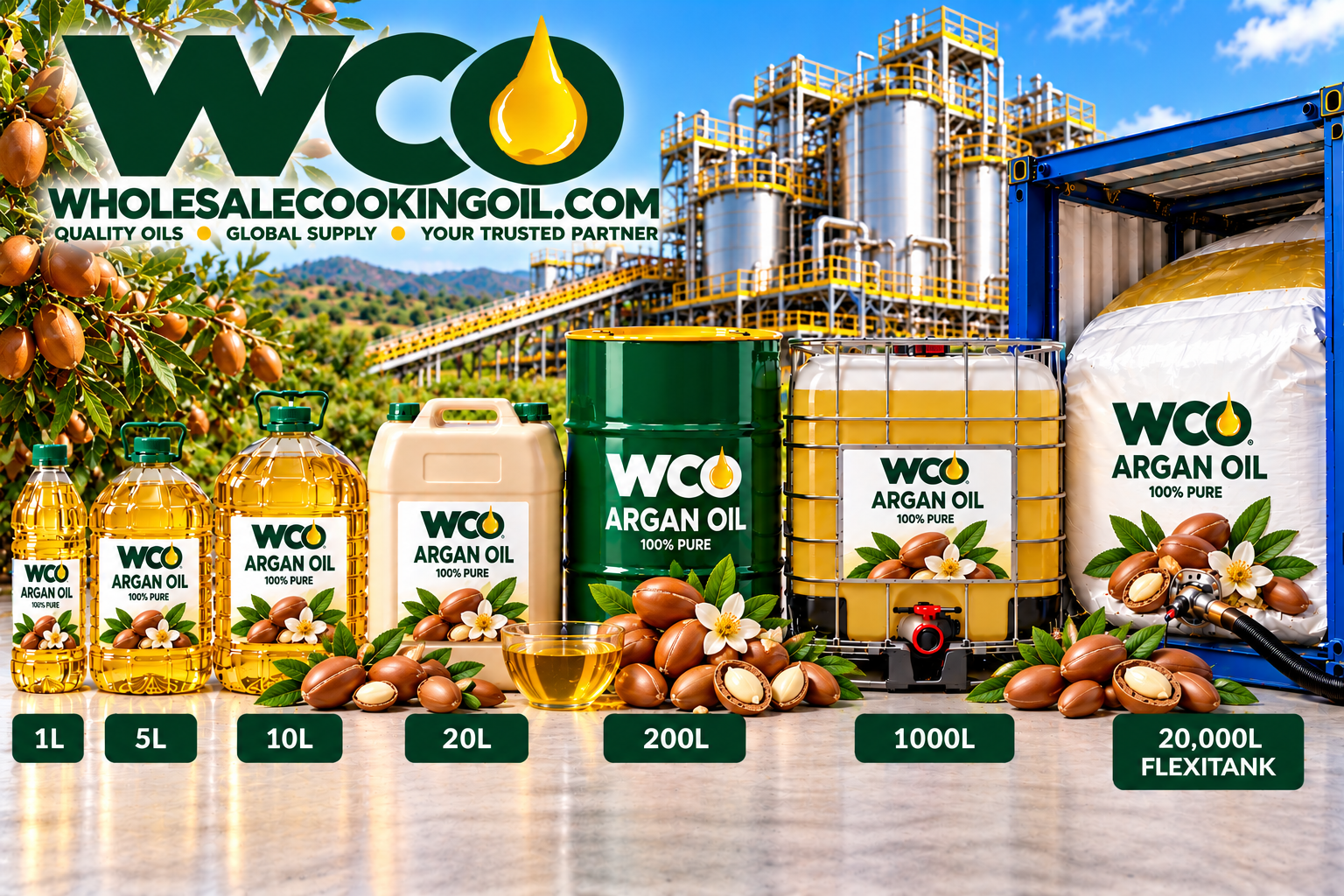
Bulk culinary argan oil, pressed from roasted argan kernels for a deep golden color and rich, nutty flavor. A rare food-grade finishing oil for dressings, Moroccan dishes and gourmet retail, supplied from 1L bottles to 20,000L flexitanks.
- Grade
- Culinary, from roasted kernels
- Flavor
- Rich, nutty, toasted
- Best for
- Finishing and gourmet retail
- Packed in
- USA
Request a quote for Argan Oil
Grade: Culinary (roasted)
1. Choose a pack size
Minimum 1,000 L (≈264 gal) per quote — mix any oils and pack sizes. Nothing to pay now: we reply by email with a quotation showing the price, shipping terms and estimated arrival date.
One of the world’s rarest culinary oils
Bulk culinary argan oil is pressed from the roasted kernels of the argan tree (Argania spinosa), which grows almost only in the dry southwest of Morocco. Roasting gives the oil a deep golden color and a rich, toasted, nutty flavor. It is a traditional finishing oil in Moroccan cooking, drizzled over couscous, tagines, salads and bread, and blended with almonds and honey into amlou.
Argan trees cannot be farmed elsewhere at scale, so our culinary argan oil is pressed near the argan forests. It is then tested and packed in the United States, and supplied from 1-liter bottles to 20,000-liter flexitanks.
Culinary vs cosmetic argan oil
| Culinary argan oil | Cosmetic argan oil | |
|---|---|---|
| Kernels | Roasted before pressing | Unroasted |
| Color and aroma | Deep golden, nutty, toasted | Pale, mild |
| Produced as | Food, under food hygiene controls | A cosmetic ingredient |
| Use | Finishing oil, dressings, amlou | Skin and hair care |
We supply culinary argan oil only. Cosmetic argan oil is not produced as food and should not be sold for eating.
Why argan oil is so valuable
- A protected forest. The argan forest is a UNESCO biosphere reserve, and supply depends on its yearly fruit crop.
- Slow to produce. Argan nuts have very hard shells, still often cracked by hand, and kernels yield relatively little oil.
- Export controls. Morocco requires an export license for argan oil in containers over 5 liters, which shapes bulk supply.
- Balanced fat profile. Roughly 43–57% oleic acid and 29–36% linoleic acid, with natural tocopherols.
How bulk argan oil is priced
Argan oil is one of the most expensive culinary oils, priced by the season’s crop, kernel quality and export conditions. Each quote is based on pack size, total volume and destination; the minimum is 1,000 liters per quote.
Technical data
Argan Oil grades and specifications
Available grades
| Grade | Description |
|---|---|
| Culinary (roasted) | Pressed from roasted argan kernels. Nutty flavor for dressings and finishing. Cosmetic argan oil is not food grade. |
Quality specification
| Parameter | Specification |
|---|---|
| Appearance (20 °C) | Clear, deep golden |
| Odor and taste | Characteristic roasted argan, free of burnt, rancid or foreign notes |
| Acid value | 2.0 mg KOH/g max. |
| Peroxide value (at packing) | 5.0 meq O₂/kg max. |
| Moisture and volatile matter | 0.10% max. |
| Insoluble impurities | 0.05% max. |
| Grade | Culinary (food); not cosmetic |
| Use | Finishing oil; not for frying |
| Shelf life (unopened) | Up to 12 months stored cool and dark in sealed packaging |
Typical specification for culinary argan oil. Argan oil quality is defined by the Moroccan standard NM 08.5.090; specifications for each shipment are supplied with your quote. Values for each lot are confirmed on the Certificate of Analysis supplied with your order.
Fatty acid profile
| Fatty acid | % of total fatty acids |
|---|---|
| Palmitic acid (C16:0) | 5.0–15.0 |
| Stearic acid (C18:0) | 4.3–12.0 |
| Oleic acid (C18:1) | 43.1–57.0 |
| Linoleic acid (C18:2) | 29.3–36.0 |
Literature ranges for argan oil cited in a peer-reviewed study of argan genotypes. Each lot is analyzed.
Source: Azizi et al., OCL, 2022: chemical characterization of argan oils
Applications
What argan oil is used for
Restaurants
A finishing oil for couscous, tagines, salads and grilled dishes.
Learn more about RestaurantsHotels and resorts
Breakfast buffets with amlou, and fine dining.
Learn more about Hotels and resortsFood manufacturing
Amlou, spreads, dressings and gourmet products.
Learn more about Food manufacturingRetail and private label
Culinary argan oil in small bottles, or under your own brand.
Learn more about Retail and private labelDistributors and importers
Drums for repacking into gourmet bottles.
Learn more about Distributors and importersPackaging
Argan Oil pack sizes
Culinary argan oil is usually ordered in 1L and 5L packs for kitchens and retail; drums suit repackers. Combine it with any other oils on the same quote.
| Pack size | US gallons | Ordered as | Liters per order unit |
|---|---|---|---|
| 1L Bottles | 0.26 gal | Case of 12 × 1L | 12 L |
| 5L Bottles | 1.3 gal | Case of 4 × 5L | 20 L |
| 10L Containers | 2.6 gal | Case of 2 × 10L | 20 L |
| 20L Jerrycans | 5.3 gal | Per jerrycan | 20 L |
| 200L Drums | 52.8 gal | Per drum | 200 L |
| 1,000L IBC Totes | 264 gal | Per IBC tote | 1,000 L |
| 20,000L Flexitanks | 5,283 gal | Per flexitank (20ft container) | 20,000 L |
Sourcing
From the argan forest to finished oil
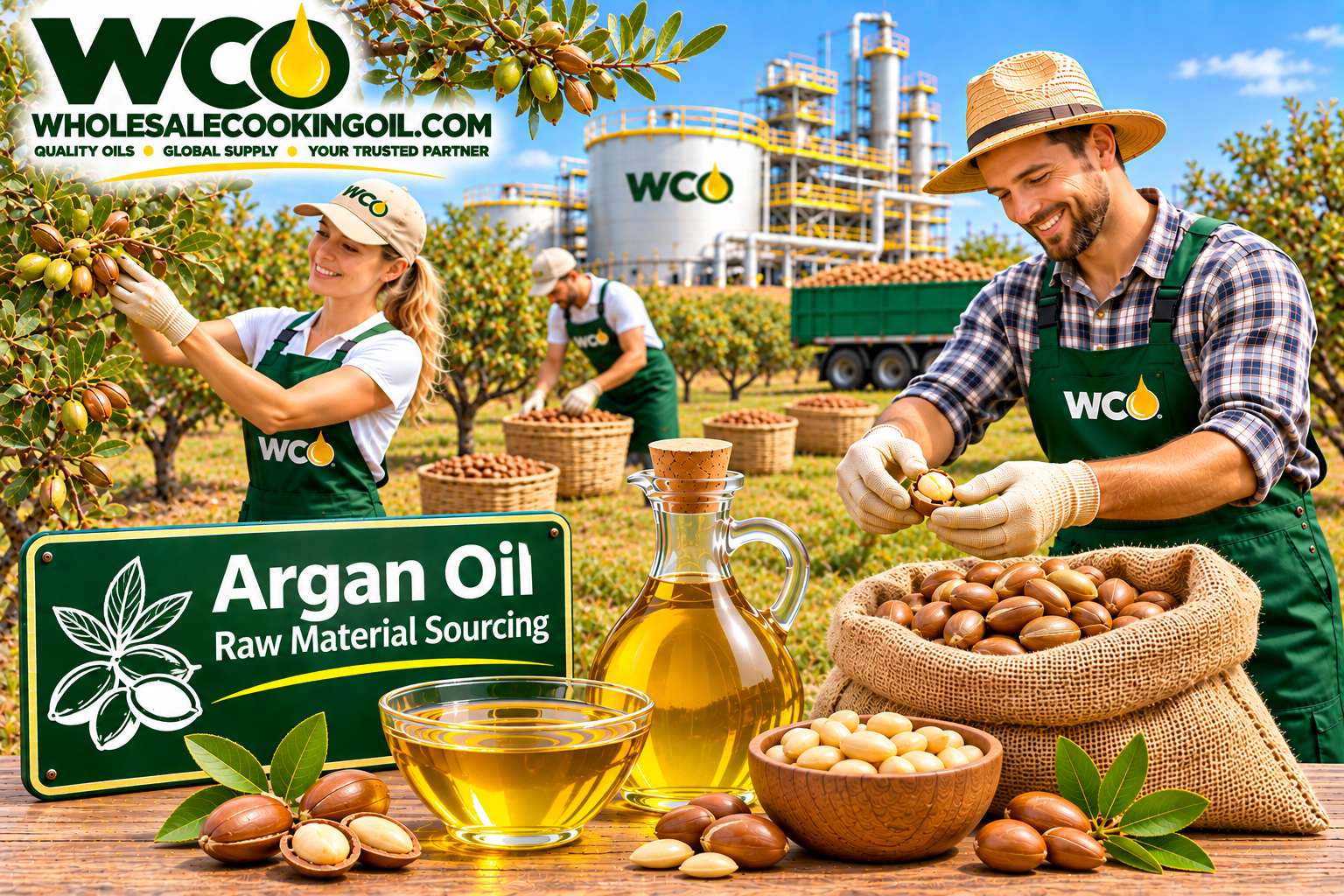
The argan tree grows almost only in southwestern Morocco, where its forest is protected as a UNESCO biosphere reserve. The fruit is dried, the very hard nuts are cracked to free the kernels, and for culinary oil the kernels are roasted and pressed close to the forest.
The oil is then shipped to the United States, where we test it against specification and pack it. Every lot is checked for acid value, peroxide value and sensory quality before filling.
Processing
How we make argan oil
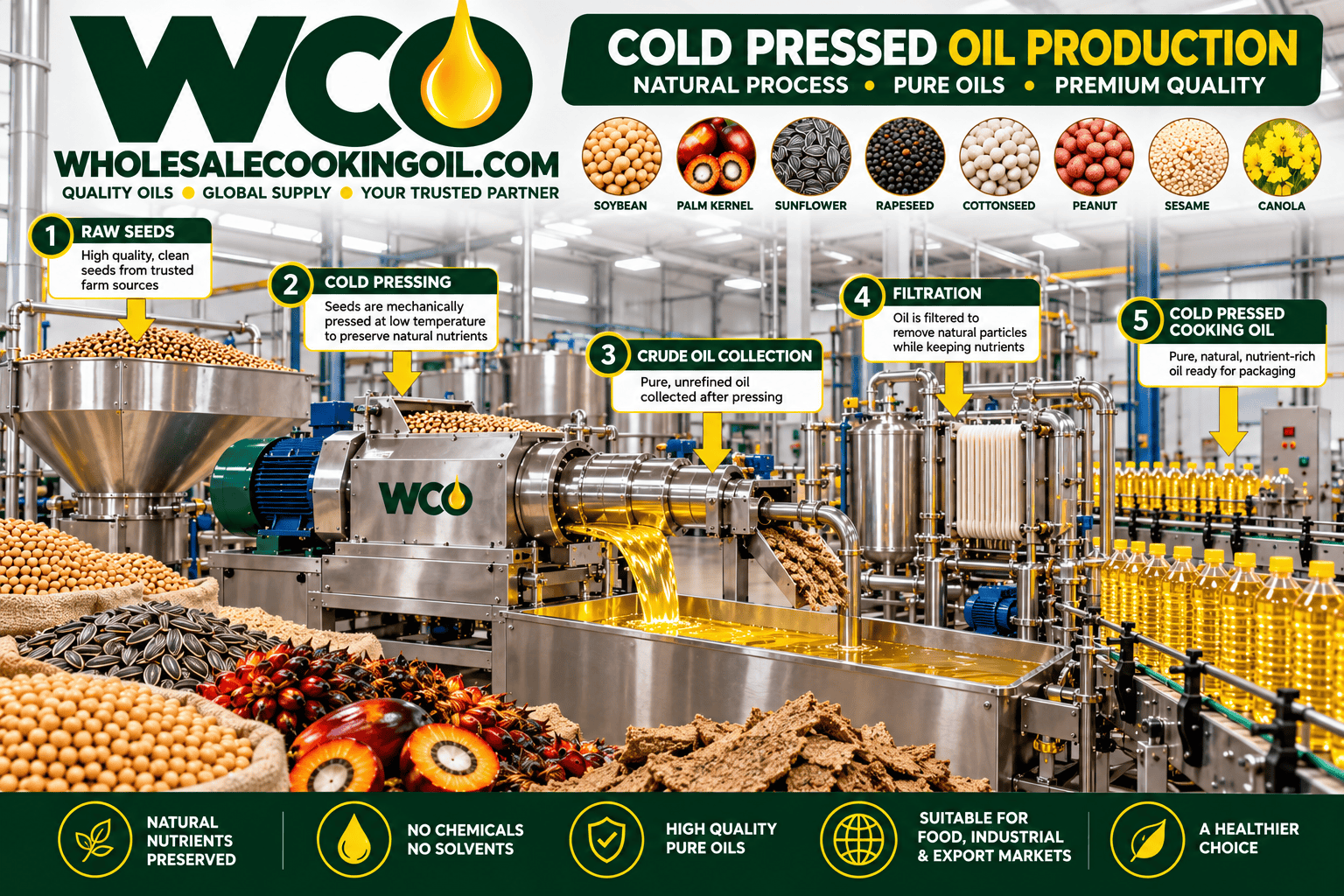
Fruit collection and drying
Ripe argan fruit is collected and dried.
Cracking
The very hard nuts are cracked to free the kernels.
Roasting
Kernels are roasted to develop the oil’s nutty flavor.
Pressing at origin
Roasted kernels are pressed near the argan forest.
Testing and packing
In the United States, each lot is tested against specification and filled into sealed, light-protected containers.
Storage & handling
Keeping argan oil fresh
Temperature
Store cool, between 10 and 20 °C (50–68 °F).
Light and air
Keep in the dark and sealed to protect its flavor.
After opening
Keep the container closed and use within a few months.
Shelf life
Up to 12 months unopened stored cool and dark.
Heat
Use as a finishing oil; heat dulls its flavor.
Buying wholesale
Wholesale argan oil supplier: how ordering works
Wholesale Cooking Oil LLC supplies argan oil in bulk direct to food businesses in the United States and worldwide. Every lot is tested and packed at our US facilities and shipped with its Certificate of Analysis. Here is what to expect when you buy argan oil wholesale from us.
Grades
Culinary (roasted). Each grade is quoted separately.
Pack sizes
1L Bottles, 5L Bottles, 10L Containers, 20L Jerrycans, 200L Drums, 1,000L IBC Totes, 20,000L Flexitanks. Mix any sizes and oils on one quote.
Minimum order
1,000 L (≈264 gal) per quote, across any combination of oils and pack sizes.
Your quotation
Free and emailed to you, valid for 7 days, showing the price, any freight and other charges, the route and an estimated arrival date.
Payment
100% in advance in US dollars, by bank transfer or cryptocurrency, against the pro forma invoice in your quotation.
Dispatch and delivery
Dispatched within 24–48 hours of payment clearing. By truck across the US (usually 1–5 business days), Canada and Mexico, or by sea from five US seaports worldwide.
Documents
A Certificate of Analysis for each lot, plus the commercial invoice, packing list and transport document. Specification sheets on request.
Who we supply
Restaurants, hotels, caterers, bakeries, food manufacturers, distributors, retailers and importers.
FAQ
Argan Oil questions
What is the minimum order?
1,000 liters (about 264 US gallons) per quote, across any combination of oils, grades and pack sizes. For example, one 1,000L IBC tote, five 200L drums, or 50 cases of 4 × 5L bottles.
Is your argan oil food grade?
Yes. We supply culinary argan oil, pressed from roasted kernels and handled as food. We do not supply cosmetic argan oil.
What is the difference between culinary and cosmetic argan oil?
Culinary oil is pressed from roasted kernels and has a nutty flavor; cosmetic oil is pressed from unroasted kernels for skin and hair care and is not produced as food.
Where is argan oil produced?
The argan tree grows almost only in southwestern Morocco, so the oil is pressed there. We test and pack it in the United States.
What is argan oil used for in cooking?
As a finishing oil on couscous, tagines, salads and bread, and in amlou, a spread of argan oil, almonds and honey.
How is the price set?
Each grade is priced separately, based on the crop, grade, pack size, total volume and delivery destination. Your quotation shows the price, any freight and other charges, the shipping terms and route, and an estimated arrival date.
Compare
Related oils
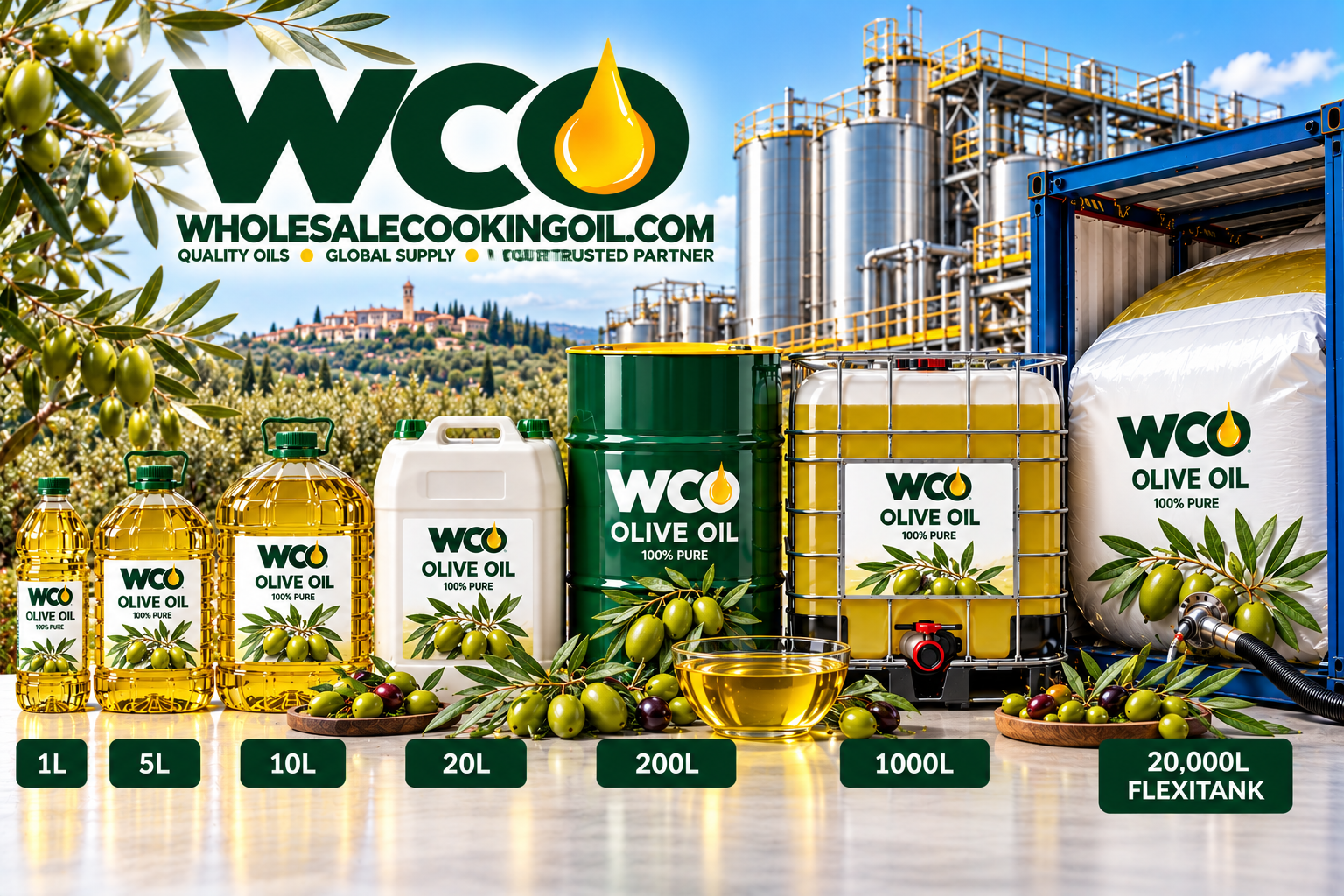
Olive Oil
Bulk olive oil in every main IOC grade, from extra virgin for dressings and finishing to olive oil and olive…
View olive oil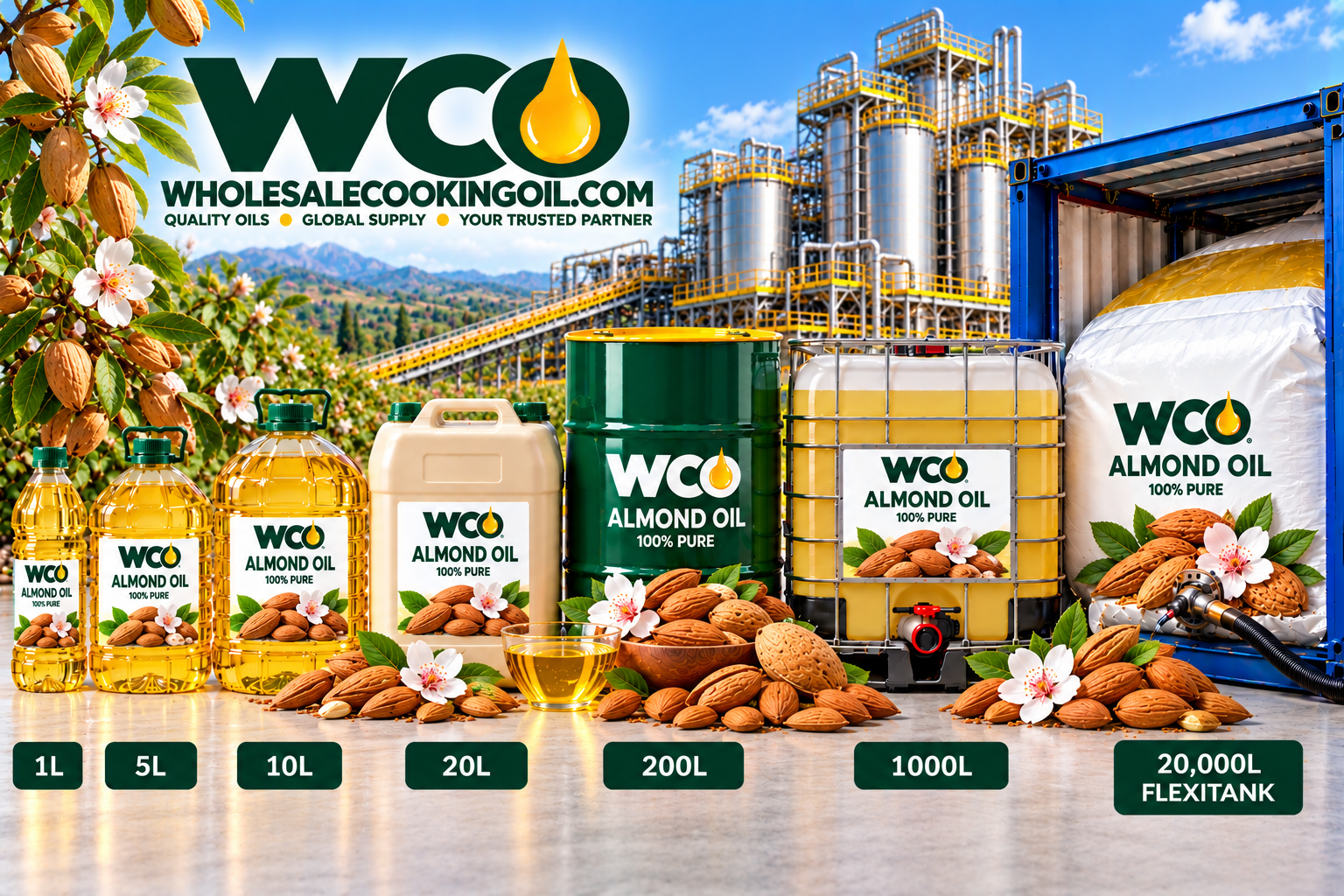
Almond Oil
Bulk sweet almond oil with a mild flavor and high oleic acid content, in cold-pressed, roasted and refined grades. For…
View almond oil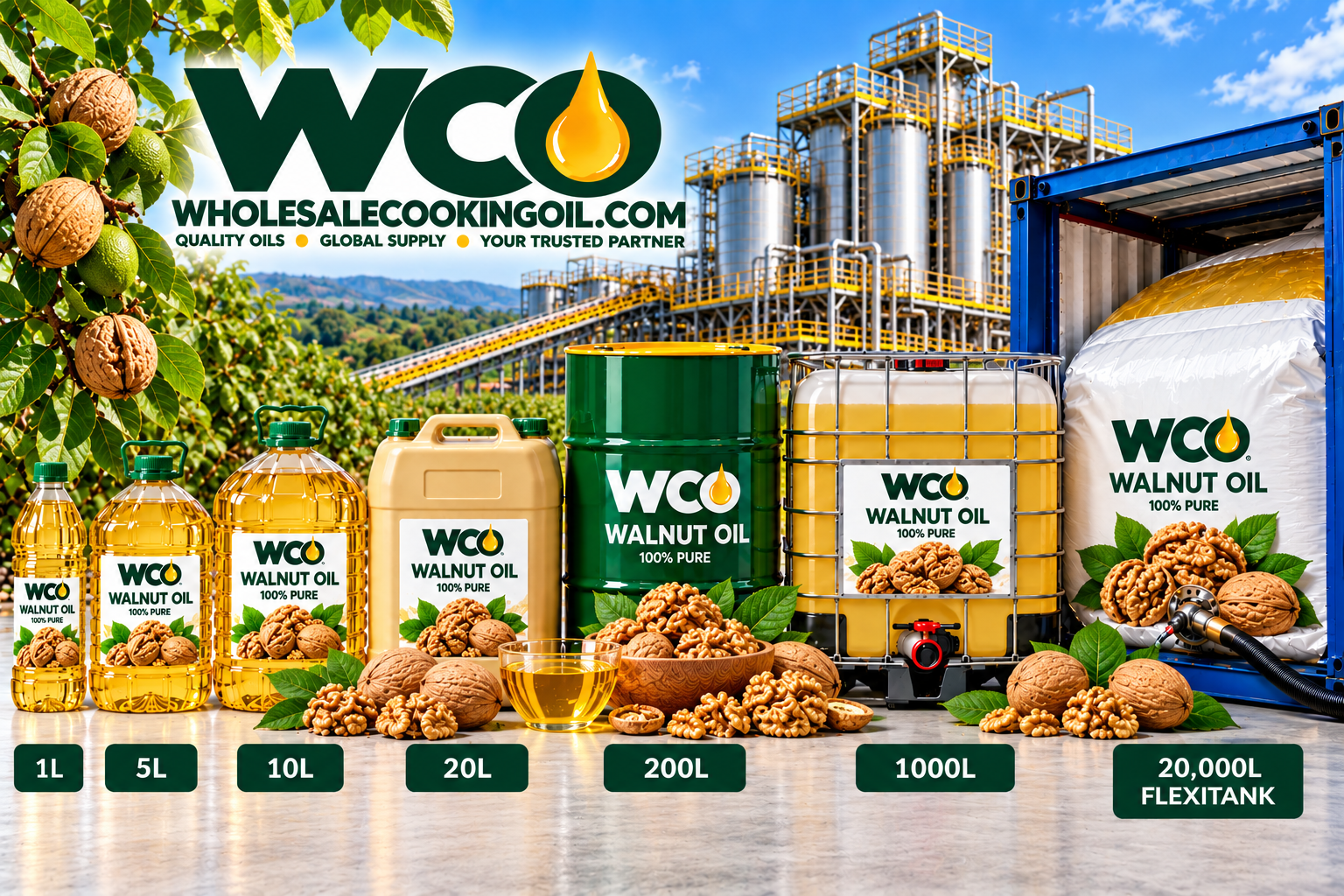
Walnut Oil
Bulk walnut oil with a delicate nutty flavor and natural plant omega-3, in cold-pressed, roasted and refined grades. For dressings,…
View walnut oil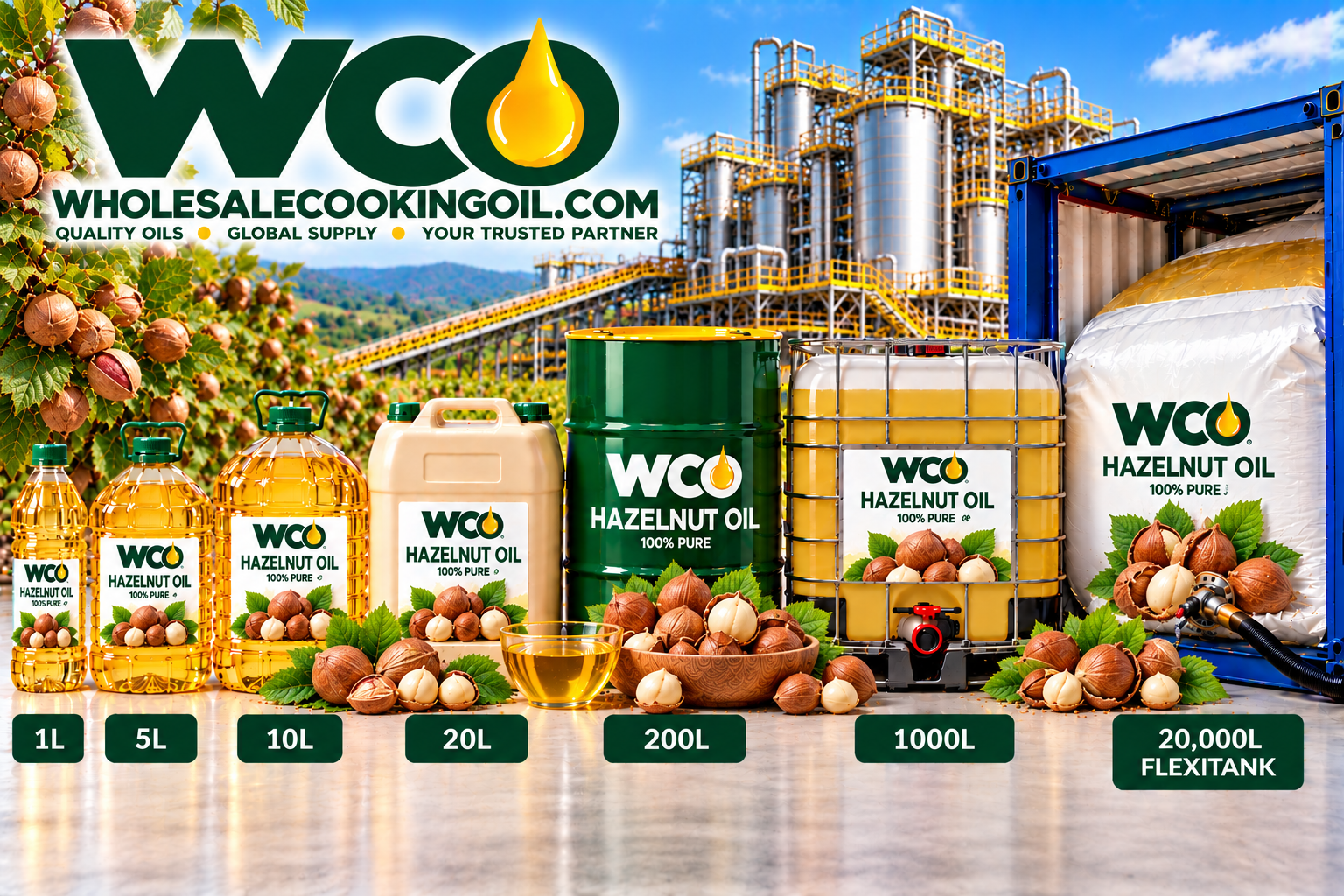
Hazelnut Oil
Bulk hazelnut oil in cold-pressed, roasted and refined grades. Very high in oleic acid, with a toasted hazelnut flavor for…
View hazelnut oil
Pumpkin Seed Oil
Bulk pumpkin seed oil: dark green roasted oil with an intense nutty flavor for finishing and gourmet retail, plus cold-pressed…
View pumpkin seed oil
Sesame Oil
Bulk sesame oil in three grades: refined for stir-frying and cooking, cold-pressed for a gentle nutty flavor, and toasted for…
View sesame oil