
Extra virgin · Virgin · Refined · Pomace
Bulk Olive Oil
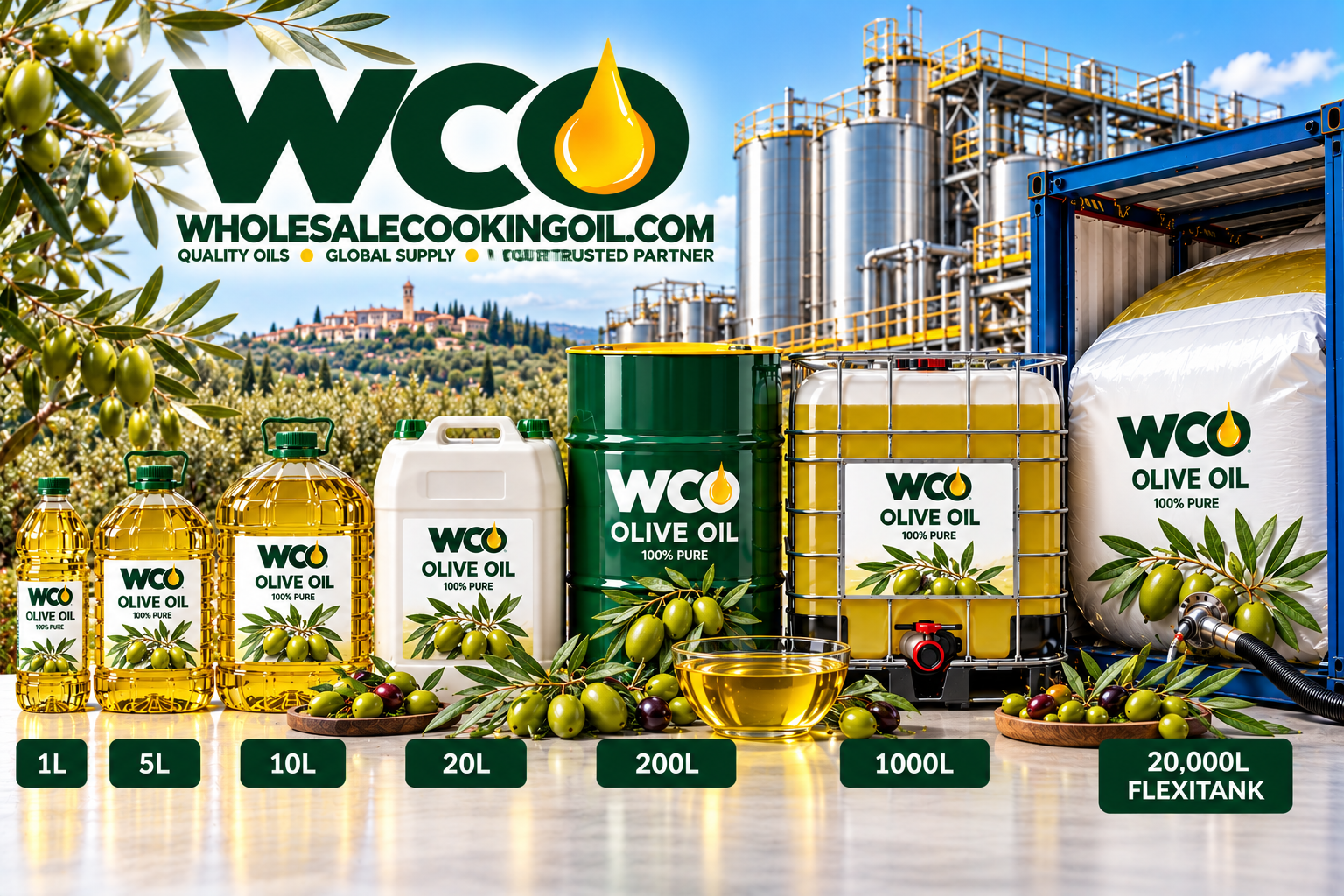
Bulk olive oil in every main IOC grade, from extra virgin for dressings and finishing to olive oil and olive pomace oil for cooking and frying. Rich in oleic acid and supplied from 1L bottles to 20,000L flexitanks.
- Grades
- Extra virgin to pomace
- Oleic acid
- 55–85%
- Standard
- IOC trade standard
- Packed in
- USA
Request a quote for Olive Oil
1. Choose a grade
2. Choose a pack size
Minimum 1,000 L (≈264 gal) per quote — mix any oils and pack sizes. Nothing to pay now: we reply by email with a quotation showing the price, shipping terms and estimated arrival date.
Every grade of olive oil, from one supplier
Bulk olive oil is not one product but a family of grades with very different flavors, uses and prices. Extra virgin olive oil brings fruit, bitterness and pepper to dressings and finishing; refined olive oil and olive pomace oil bring olive oil’s stable, monounsaturated profile to cooking and frying at a lower cost. We supply all the main grades defined by the International Olive Council (IOC) trade standard, so you can buy the right grade for each use in one order.
Our olive oils are packed in the United States and supplied from 1-liter bottles to 20,000-liter flexitanks for restaurants, food manufacturers, importers and retail brands.
Olive oil grades explained
| Grade | How it is made | Free acidity | Best for |
|---|---|---|---|
| Extra virgin olive oil | Mechanically extracted, no refining; no sensory defects | 0.8% max. | Dressings, finishing, premium retail |
| Virgin olive oil | Mechanically extracted, no refining; minor sensory defects allowed | 2.0% max. | Cooking and dressings at a lower price |
| Olive oil (refined and virgin blend) | Refined olive oil blended with virgin olive oil | 1.0% max. | Everyday cooking, sautéing, baking |
| Refined olive oil | Refined from virgin olive oils | 0.3% max. | Food manufacturing, neutral uses |
| Olive pomace oil | Refined pomace oil blended with virgin olive oil | 1.0% max. | Frying and high-volume cooking |
Limits from the International Olive Council trade standard. Under IOC rules, olive pomace oil may never be sold as “olive oil”.
What makes an oil “extra virgin”
Virgin olive oils must be obtained from the olive fruit solely by mechanical or other physical means, under conditions, especially of temperature, that do not alter the oil, and may only be washed, decanted, centrifuged and filtered. To be extra virgin, the oil must also pass both a chemical test, with free acidity of 0.8% or less and limits on peroxide value and ultraviolet absorbance that reveal oxidation and refining, and an official sensory panel test showing fruitiness and no defects.
Can you cook and fry with olive oil?
Yes. Olive oil is rich in oleic acid, typically 55–85% of its fatty acids, which makes it more stable under heat than many seed oils. Extra virgin olive oil is excellent for sautéing and moderate-temperature cooking, though its flavor and higher price make it less economical for deep frying. For frying and high-volume cooking, olive oil (the refined and virgin blend) or olive pomace oil give olive oil’s stability at a much lower cost.
How bulk olive oil is priced
Olive oil prices follow olive harvests, which vary a great deal from year to year with weather in the main growing regions. Extra virgin costs the most and pomace oil the least. Each grade is quoted separately on pack size, total volume and destination; the minimum is 1,000 liters per quote.
Technical data
Olive Oil grades and specifications
Available grades
| Grade | Description |
|---|---|
| Extra virgin olive oil | Top grade of virgin olive oil: free acidity 0.8% max. and no sensory defects. Full fruity flavor. |
| Virgin olive oil | Virgin olive oil with free acidity 2.0% max. Good flavor at a lower price. |
| Olive oil (refined and virgin blend) | Refined olive oil blended with virgin olive oil; free acidity 1.0% max. Mild flavor for everyday cooking. |
| Refined olive oil | Refined from virgin olive oils; free acidity 0.3% max. Neutral flavor, mainly for food manufacturing. |
| Olive pomace oil | Refined olive pomace oil blended with virgin olive oil; free acidity 1.0% max. Economical for frying. Cannot be sold as "olive oil". |
Each grade is priced separately. The specifications below are for Extra virgin olive oil; specifications for other grades are supplied with your quote.
Quality specification
| Parameter | Specification |
|---|---|
| Free acidity (as oleic acid) | 0.8% max. |
| Peroxide value | 20 meq O₂/kg max. |
| Ultraviolet absorbance K270 | 0.22 max. |
| ΔK | 0.01 max. |
| Sensory: median of defects | 0 |
| Sensory: median of fruitiness | Greater than 0 |
| Appearance | Clear, green to golden |
| Shelf life (unopened) | 18 months from bottling, stored cool and away from light |
Specification for extra virgin olive oil under the International Olive Council trade standard (COI/T.15/NC No 3). Specifications for the other grades are supplied with your quote. Values for each lot are confirmed on the Certificate of Analysis supplied with your order.
Fatty acid profile
| Fatty acid | % of total fatty acids |
|---|---|
| Palmitic acid (C16:0) | 7.00–20.00 |
| Palmitoleic acid (C16:1) | 0.30–3.50 |
| Stearic acid (C18:0) | 0.50–5.00 |
| Oleic acid (C18:1) | 55.00–85.00 |
| Linoleic acid (C18:2) | 2.50–21.00 |
| Linolenic acid (C18:3) | 1.00 max. |
| Arachidic acid (C20:0) | Under 0.60 |
Fatty acid composition limits for olive oils from the International Olive Council trade standard.
Source: International Olive Council trade standard for olive oils and olive pomace oils
Applications
What olive oil is used for
Restaurants and cafés
Extra virgin for dressings and finishing; olive oil or pomace oil for sautéing and frying.
Learn more about Restaurants and cafésRetail and private label
Extra virgin and olive oil in 1L and 5L bottles for supermarket shelves, or under your own brand.
Learn more about Retail and private labelFood manufacturing
Sauces, dressings, marinades, tapenades and ready meals labeled with olive oil.
Learn more about Food manufacturingHotels and catering
Different grades for buffets, dressings and hot kitchens in one order.
Learn more about Hotels and cateringDistributors and importers
Bulk grades in drums, IBC totes and flexitanks for repacking and distribution.
Learn more about Distributors and importersPackaging
Olive Oil pack sizes
Combine any olive oil grades with other oils on the same quote, for example extra virgin in 1L bottles for retail and olive pomace oil in 20L jerrycans for your kitchens.
| Pack size | US gallons | Ordered as | Liters per order unit |
|---|---|---|---|
| 1L Bottles | 0.26 gal | Case of 12 × 1L | 12 L |
| 5L Bottles | 1.3 gal | Case of 4 × 5L | 20 L |
| 10L Containers | 2.6 gal | Case of 2 × 10L | 20 L |
| 20L Jerrycans | 5.3 gal | Per jerrycan | 20 L |
| 200L Drums | 52.8 gal | Per drum | 200 L |
| 1,000L IBC Totes | 264 gal | Per IBC tote | 1,000 L |
| 20,000L Flexitanks | 5,283 gal | Per flexitank (20ft container) | 20,000 L |
Sourcing
From olive groves to finished oil
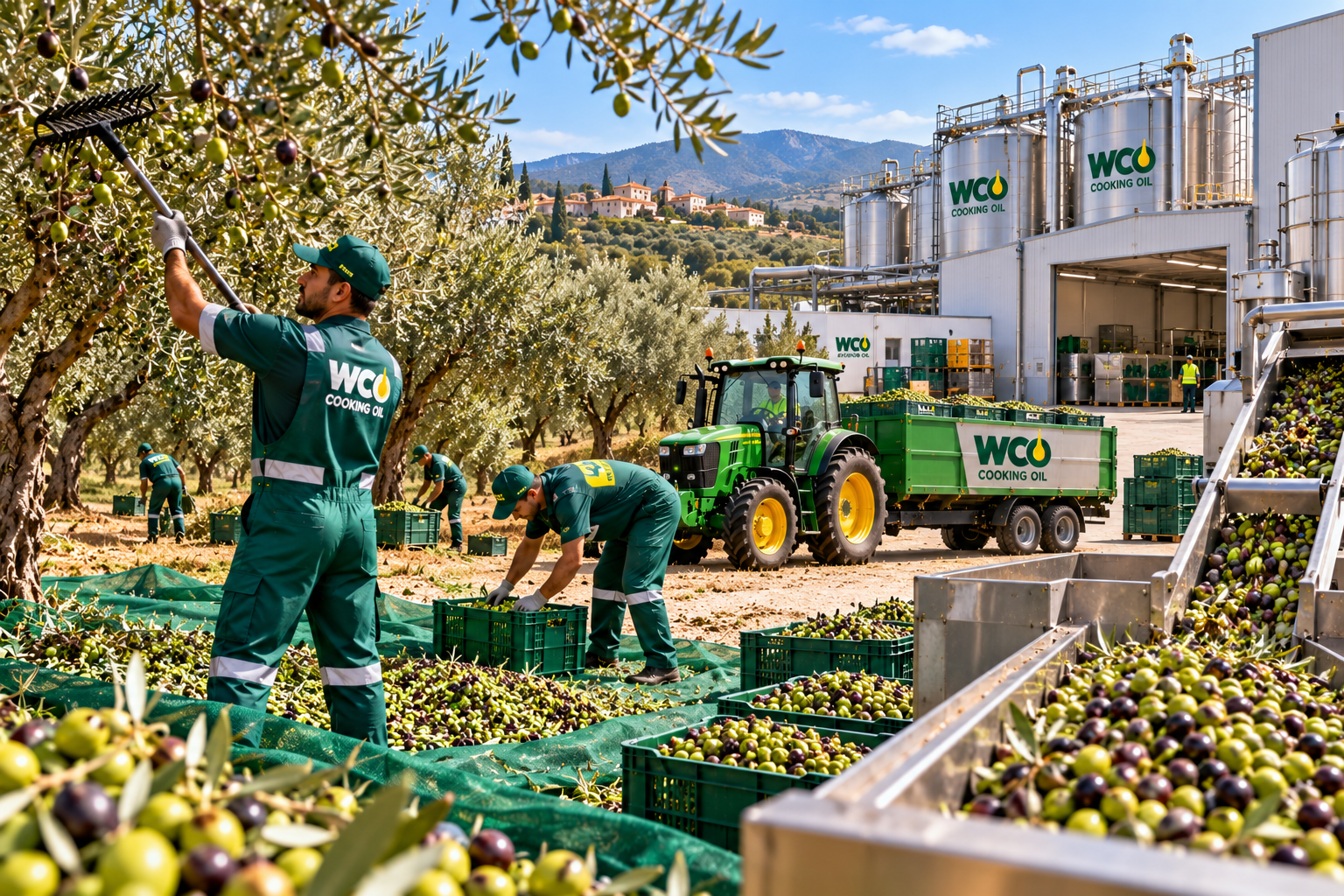
Olives have to be milled soon after picking to keep acidity low and flavor fresh, so virgin olive oils are extracted at mills close to the groves in olive-growing regions.
We then test, blend, refine where the grade requires it, and pack our olive oils in the United States. Each lot is checked against the IOC limits for its grade before packing.
Processing
How we make olive oil
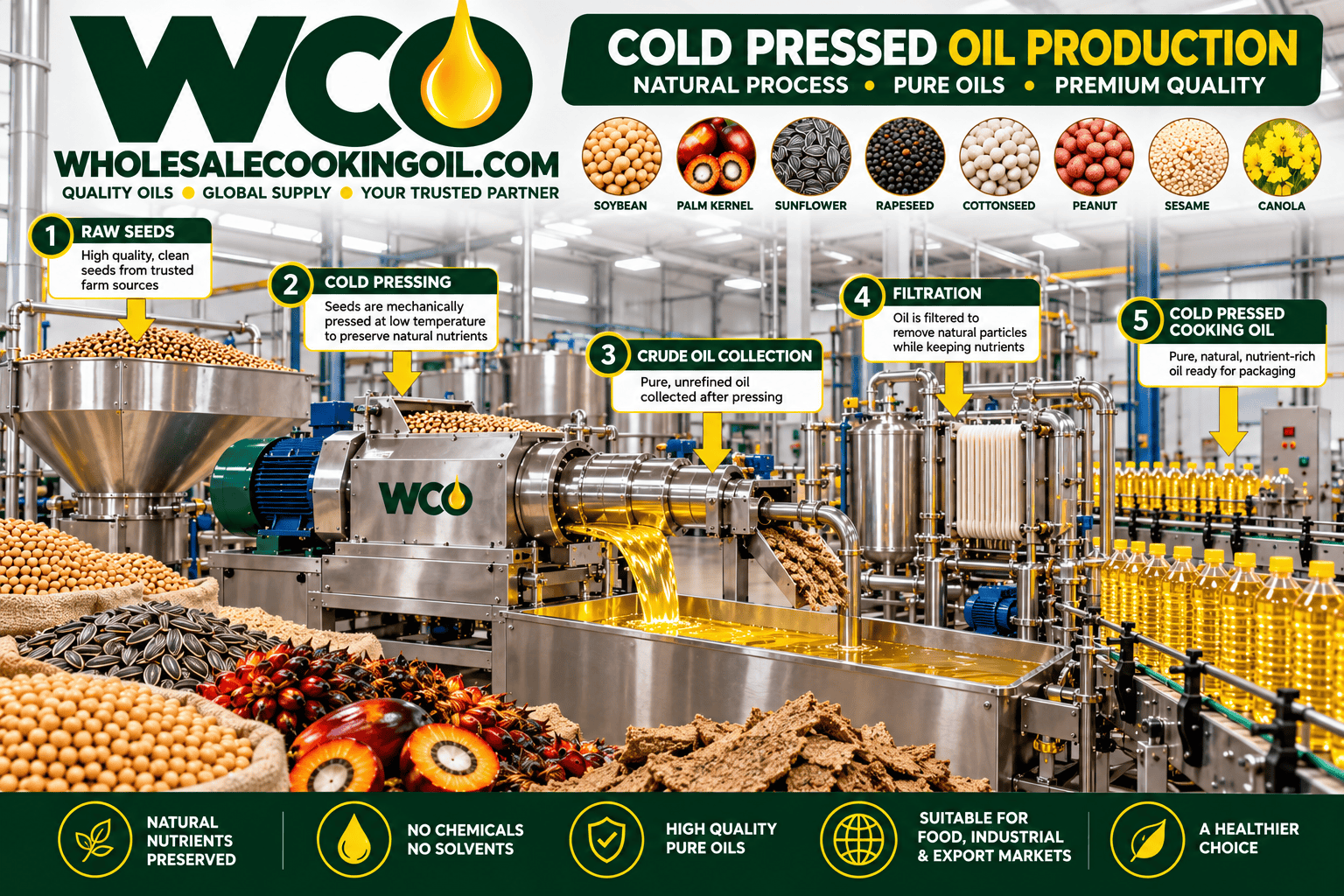
Harvesting
Olives are picked and taken to the mill quickly to keep acidity low.
Milling and malaxing
The olives are crushed into a paste and gently mixed so the oil droplets come together.
Separation
Oil is separated from water and solids by centrifuge, without heat that would alter it.
Filtering and storage
Virgin oils are filtered and stored away from light and air.
Refining (refined grades only)
Lower-grade virgin oils and pomace oil are refined, then blended with virgin oil for olive oil and olive pomace oil.
Testing and packing
Each lot is tested against the IOC limits for its grade, then packed.
Storage & handling
Keeping olive oil fresh
Temperature
Store between 10 and 25 °C (50–77 °F), away from heat sources.
Light and air
Keep containers sealed and away from light. Light and oxygen are the main causes of rancidity, especially in virgin oils.
Shelf life
About 18 months from bottling unopened. Extra virgin olive oil is at its best when used within months of opening.
Cold storage
Olive oil may turn cloudy or partly solid below about 10 °C (50 °F). This is natural and reverses at room temperature.
Buying wholesale
Wholesale olive oil supplier: how ordering works
Wholesale Cooking Oil LLC supplies olive oil in bulk direct to food businesses in the United States and worldwide. Every lot is tested and packed at our US facilities and shipped with its Certificate of Analysis. Here is what to expect when you buy olive oil wholesale from us.
Grades
Extra virgin olive oil, Virgin olive oil, Olive oil (refined and virgin blend), Refined olive oil, Olive pomace oil. Each grade is quoted separately.
Pack sizes
1L Bottles, 5L Bottles, 10L Containers, 20L Jerrycans, 200L Drums, 1,000L IBC Totes, 20,000L Flexitanks. Mix any sizes and oils on one quote.
Minimum order
1,000 L (≈264 gal) per quote, across any combination of oils and pack sizes.
Your quotation
Free and emailed to you, valid for 7 days, showing the price, any freight and other charges, the route and an estimated arrival date.
Payment
100% in advance in US dollars, by bank transfer or cryptocurrency, against the pro forma invoice in your quotation.
Dispatch and delivery
Dispatched within 24–48 hours of payment clearing. By truck across the US (usually 1–5 business days), Canada and Mexico, or by sea from five US seaports worldwide.
Documents
A Certificate of Analysis for each lot, plus the commercial invoice, packing list and transport document. Specification sheets on request.
Who we supply
Restaurants, hotels, caterers, bakeries, food manufacturers, distributors, retailers and importers.
FAQ
Olive Oil questions
What is the minimum order?
1,000 liters (about 264 US gallons) per quote, across any combination of oils, grades and pack sizes. For example, one 1,000L IBC tote, five 200L drums, or 50 cases of 4 × 5L bottles.
What is the difference between extra virgin and virgin olive oil?
Both are unrefined oils extracted mechanically. Extra virgin has free acidity of 0.8% or less and no sensory defects; virgin olive oil may have acidity up to 2.0% and minor defects.
What is “olive oil” without “virgin” on the label?
It is a blend of refined olive oil and virgin olive oil, with a milder flavor and free acidity of 1.0% or less. It is designed for everyday cooking.
What is olive pomace oil?
Oil recovered from the olive paste left after pressing, refined and blended with virgin olive oil. It is the most economical grade and is widely used for frying, but it cannot be sold as “olive oil”.
Can you fry with olive oil?
Yes. Its high oleic acid content makes it stable under heat. For deep frying, olive oil or olive pomace oil is more economical than extra virgin.
Why does olive oil go cloudy in the cold?
Natural waxes and saturated fats solidify below about 10 °C. This does not affect quality and clears at room temperature.
How is the price set?
Each grade is priced separately, based on the crop, grade, pack size, total volume and delivery destination. Your quotation shows the price, any freight and other charges, the shipping terms and route, and an estimated arrival date.
Compare
Related oils
Avocado Oil
Bulk avocado oil pressed from avocado fruit: refined for a neutral taste and very high smoke point, or extra virgin…
View avocado oil
Sunflower Oil
Bulk sunflower oil, refined and winterized, with a clean, neutral taste and a high smoke point. Processed and packed in…
View sunflower oil
High-Oleic Sunflower Oil
Bulk high-oleic sunflower oil with at least 75% oleic acid and almost no omega-3, for long fry life and extended…
View high-oleic sunflower oil
Canola Oil
Bulk canola oil, refined for a clean, neutral taste, with the lowest saturated fat of common cooking oils and natural…
View canola oil
Grapeseed Oil
Bulk grapeseed oil from the wine harvest: refined for a pale color and clean, light taste, or cold-pressed with a…
View grapeseed oil
Sesame Oil
Bulk sesame oil in three grades: refined for stir-frying and cooking, cold-pressed for a gentle nutty flavor, and toasted for…
View sesame oil