Highly refined · Cold-pressed · Roasted
Bulk Peanut Oil
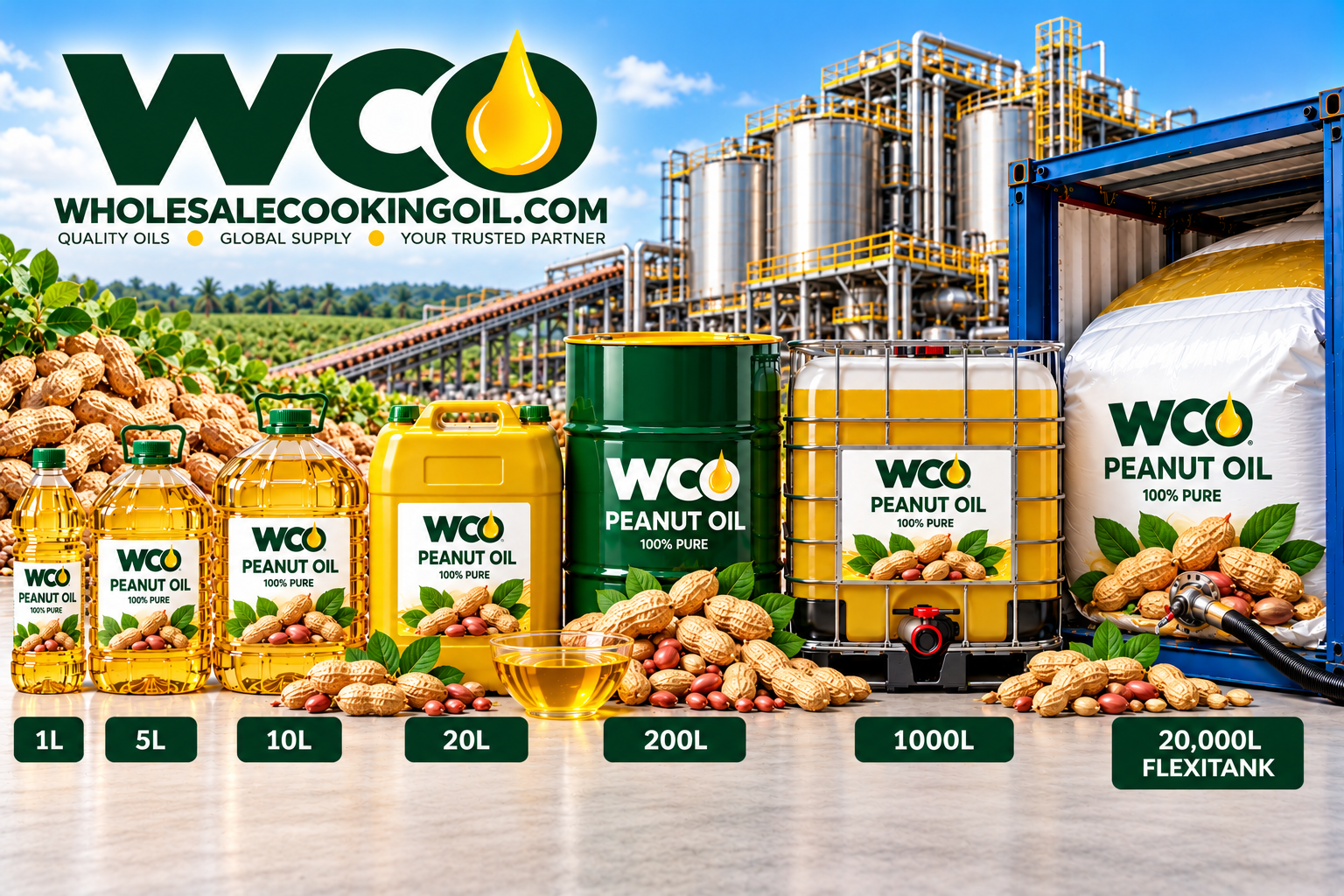
Bulk peanut oil: highly refined for deep frying with a neutral taste and high smoke point, plus cold-pressed and roasted grades for rich peanut flavor. Supplied from 1L bottles to 20,000L flexitanks.
- Grades
- Refined, cold-pressed, roasted
- Smoke point (refined)
- About 230 °C / 450 °F
- Best for
- Deep frying
- Processed in
- USA
Request a quote for Peanut Oil
1. Choose a grade
2. Choose a pack size
Minimum 1,000 L (≈264 gal) per quote — mix any oils and pack sizes. Nothing to pay now: we reply by email with a quotation showing the price, shipping terms and estimated arrival date.
A classic frying oil with a clean finish
Bulk peanut oil has long been a favorite of fry cooks, from fried chicken and fries to Asian stir-fries and whole-turkey frying. Highly refined peanut oil has a high smoke point, a neutral taste and does not carry flavors from one batch of food to the next, so chicken, fish and fries can share a fryer. Cold-pressed and roasted peanut oils go the other way, keeping a rich peanut aroma for dressings, sauces and seasoning.
Our peanut oil is processed and packed in the United States from US-grown and imported peanuts, and supplied from 1-liter bottles to 20,000-liter flexitanks.
Peanut oil grades and allergens
| Highly refined | Cold-pressed (unrefined) | Roasted (gourmet) | |
|---|---|---|---|
| Flavor | Neutral | Mild peanut | Strong roasted peanut |
| Smoke point | About 230 °C (450 °F) | Lower | Lower |
| Best for | Deep frying, stir-frying | Dressings, light cooking | Seasoning, sauces, finishing |
| Peanut protein | Removed by refining | Present | Present |
| US allergen labeling | Exempt as a highly refined oil | Must be labeled as peanut | Must be labeled as peanut |
Under the US Food Allergen Labeling and Consumer Protection Act, highly refined oils are excluded from the definition of a major food allergen, because refining removes the protein that triggers reactions. Cold-pressed and roasted peanut oils keep peanut protein and must be labeled as a peanut allergen. Rules differ outside the US; Canada, for example, requires refined peanut oil to be declared. Always confirm the labeling requirements in the market where your product is sold.
Why fry cooks choose peanut oil
- High smoke point. Highly refined peanut oil smokes at about 230 °C (450 °F), comfortably above frying temperatures.
- Does not transfer flavors. Different foods can be fried in the same oil without tasting of each other.
- Very little omega-3. Alpha-linolenic acid is 0.3% or less, which helps stability in the fryer.
- Crisp, golden results. A long-standing choice for fried chicken, fries and battered foods.
How bulk peanut oil is priced
Peanut oil prices follow peanut harvests and global vegetable oil markets, and it usually costs more than soybean or canola oil. Cold-pressed and roasted grades cost more than refined. Each grade is quoted separately on pack size, total volume and destination; the minimum is 1,000 liters per quote.
Technical data
Peanut Oil grades and specifications
Available grades
| Grade | Description |
|---|---|
| Highly refined | Neutral taste and high smoke point, widely used for deep frying. In the US, highly refined peanut oil is exempt from allergen labeling. |
| Cold-pressed (unrefined) | Mild peanut flavor. Contains peanut protein and must be labeled as a peanut allergen. |
| Roasted (gourmet) | Pressed from roasted peanuts for a strong peanut aroma. Contains peanut protein and must be labeled as a peanut allergen. |
Each grade is priced separately. The specifications below are for Highly refined; specifications for other grades are supplied with your quote.
Quality specification
| Parameter | Specification |
|---|---|
| Appearance (20 °C) | Clear, bright, free of sediment |
| Odor and taste | Bland, neutral, free of foreign odors |
| Color (Lovibond, 5¼ in. cell) | 2.0 red max. |
| Free fatty acids (as oleic acid) | 0.10% max. |
| Peroxide value (at packing) | 1.0 meq O₂/kg max. |
| Moisture and volatile matter | 0.05% max. |
| Insoluble impurities | 0.05% max. |
| Iodine value (Wijs) | 86–107 |
| Saponification value | 187–196 mg KOH/g |
| Relative density (20 °C) | 0.912–0.920 |
| Refractive index (40 °C) | 1.460–1.465 |
| Smoke point | About 230 °C / 450 °F |
| Shelf life (unopened) | Up to 18 months; 12 months for IBC and flexitank deliveries |
Typical specification for highly refined peanut oil. Identity values follow the Codex Alimentarius standard for arachis (groundnut) oil. Specifications for cold-pressed and roasted grades are supplied with your quote. Values for each lot are confirmed on the Certificate of Analysis supplied with your order.
Fatty acid profile
| Fatty acid | % of total fatty acids |
|---|---|
| Palmitic acid (C16:0) | 8.0–14.0 |
| Stearic acid (C18:0) | 1.0–4.5 |
| Oleic acid (C18:1) | 35.0–69.0 |
| Linoleic acid (C18:2) | 12.0–43.0 |
| Alpha-linolenic acid (C18:3) | 0.3 max. |
| Arachidic acid (C20:0) | 1.0–2.0 |
| Behenic acid (C22:0) | 1.5–4.5 |
| Lignoceric acid (C24:0) | 0.5–2.5 |
Ranges for arachis (groundnut) oil from the Codex Alimentarius Standard for Named Vegetable Oils. Peanut oil’s long-chain saturated fats (behenic and lignoceric acid) are why it can turn cloudy in the cold.
Source: Codex Alimentarius Standard for Named Vegetable Oils (CXS 210-1999)
Applications
What peanut oil is used for
Fast food and chicken restaurants
Highly refined peanut oil for fried chicken, fries and fish, sharing fryers without flavor transfer.
Learn more about Fast food and chicken restaurantsSauce and seasoning makers
Roasted peanut oil for satay, dressings and Asian sauces.
Learn more about Sauce and seasoning makersCatering and events
Deep frying in high volumes, including whole-turkey frying.
Learn more about Catering and eventsRetail and private label
1L and 5L bottles of refined or roasted peanut oil, or under your own brand.
Learn more about Retail and private labelPackaging
Peanut Oil pack sizes
Combine peanut oil grades with any other oils on the same quote. 20L jerrycans and 200L drums suit most fryers.
| Pack size | US gallons | Ordered as | Liters per order unit |
|---|---|---|---|
| 1L Bottles | 0.26 gal | Case of 12 × 1L | 12 L |
| 5L Bottles | 1.3 gal | Case of 4 × 5L | 20 L |
| 10L Containers | 2.6 gal | Case of 2 × 10L | 20 L |
| 20L Jerrycans | 5.3 gal | Per jerrycan | 20 L |
| 200L Drums | 52.8 gal | Per drum | 200 L |
| 1,000L IBC Totes | 264 gal | Per IBC tote | 1,000 L |
| 20,000L Flexitanks | 5,283 gal | Per flexitank (20ft container) | 20,000 L |
Sourcing
From peanut fields to finished oil
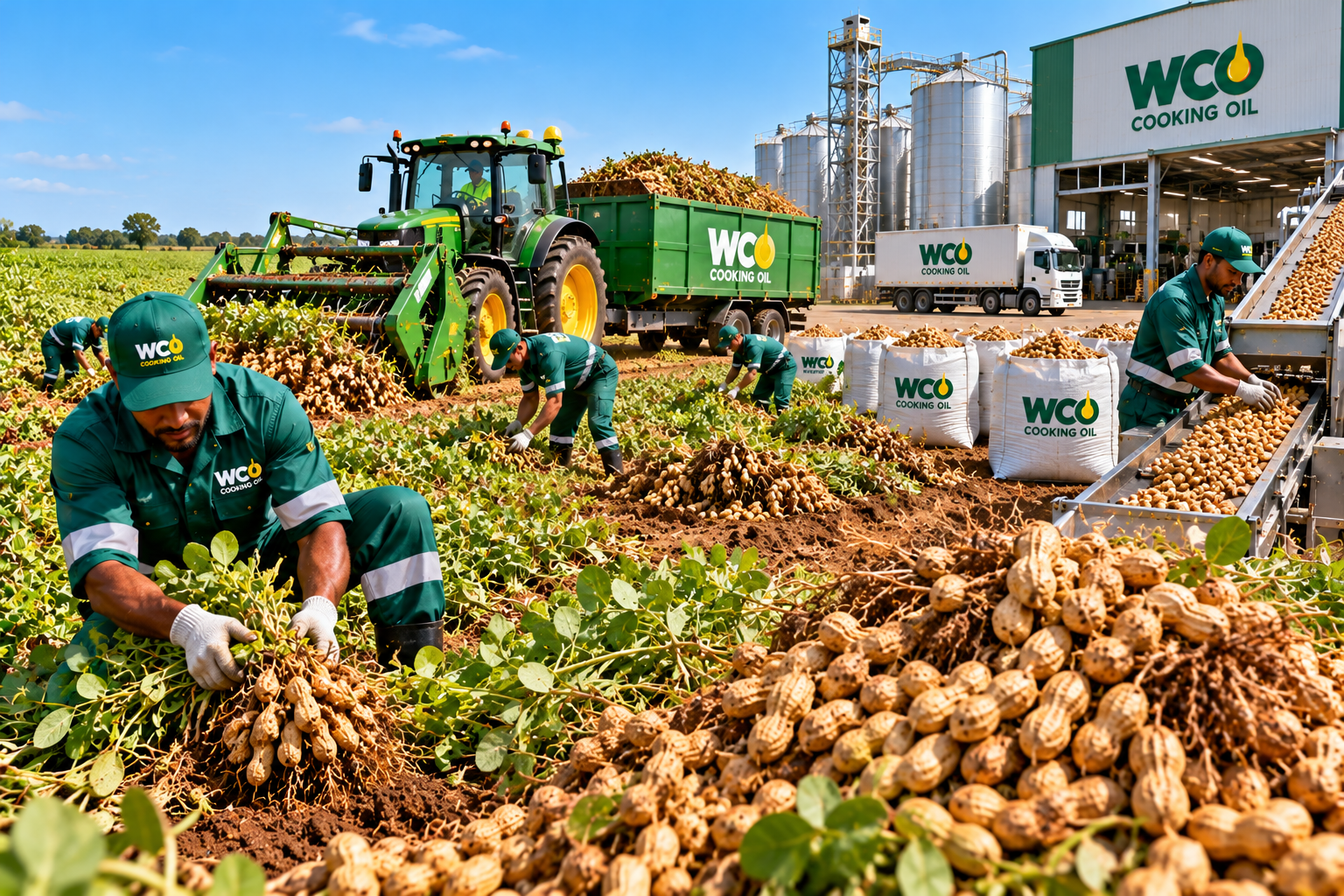
Our peanut oil is processed and packed in the United States from US-grown and imported peanuts. Peanuts are shelled and cleaned before pressing; for roasted oil they are roasted first to develop their aroma.
Highly refined oil is fully refined, bleached and deodorized, which removes the peanut protein. Every batch is tested and packed at our US facilities.
Processing
How we make peanut oil
Shelling and cleaning
Peanuts are shelled, cleaned and sorted.
Roasting (roasted grade)
Kernels for roasted oil are roasted for flavor.
Pressing
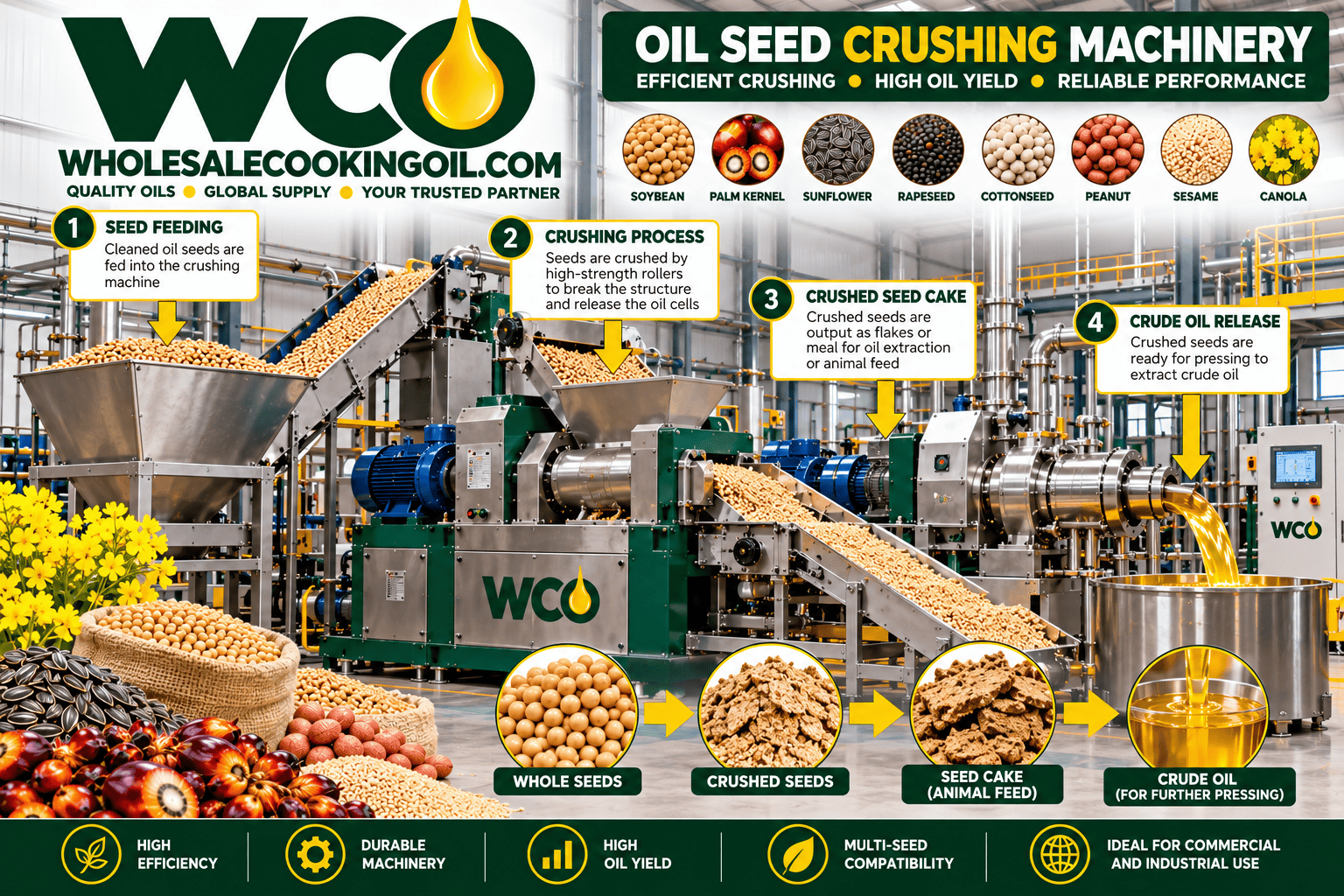
Kernels are mechanically pressed to release the oil.
Refining (refined grade)
Degumming, neutralizing, bleaching and deodorizing remove protein, flavor and impurities.
Filtering
Cold-pressed and roasted oils are filtered only.
Testing and packing
Each batch is tested against specification, then packed.
Storage & handling
Keeping peanut oil fresh
Temperature
Store between 10 and 25 °C (50–77 °F), away from heat sources.
Light and air
Keep containers sealed and out of direct sunlight to prevent rancidity.
Cold storage
Peanut oil can turn cloudy or thicken in the refrigerator or cold storage. This is natural and clears at room temperature.
Shelf life
Up to 18 months unopened for refined oil; roasted and cold-pressed oils are best within a year.
In the fryer
Fry at 170–180 °C, filter daily, top up with fresh oil, and replace the oil when it darkens, foams or smokes at normal frying temperature.
Buying wholesale
Wholesale peanut oil supplier: how ordering works
Wholesale Cooking Oil LLC supplies peanut oil in bulk direct to food businesses in the United States and worldwide. Every lot is tested and packed at our US facilities and shipped with its Certificate of Analysis. Here is what to expect when you buy peanut oil wholesale from us.
Grades
Highly refined, Cold-pressed (unrefined), Roasted (gourmet). Each grade is quoted separately.
Pack sizes
1L Bottles, 5L Bottles, 10L Containers, 20L Jerrycans, 200L Drums, 1,000L IBC Totes, 20,000L Flexitanks. Mix any sizes and oils on one quote.
Minimum order
1,000 L (≈264 gal) per quote, across any combination of oils and pack sizes.
Your quotation
Free and emailed to you, valid for 7 days, showing the price, any freight and other charges, the route and an estimated arrival date.
Payment
100% in advance in US dollars, by bank transfer or cryptocurrency, against the pro forma invoice in your quotation.
Dispatch and delivery
Dispatched within 24–48 hours of payment clearing. By truck across the US (usually 1–5 business days), Canada and Mexico, or by sea from five US seaports worldwide.
Documents
A Certificate of Analysis for each lot, plus the commercial invoice, packing list and transport document. Specification sheets on request.
Who we supply
Restaurants, hotels, caterers, bakeries, food manufacturers, distributors, retailers and importers.
FAQ
Peanut Oil questions
What is the minimum order?
1,000 liters (about 264 US gallons) per quote, across any combination of oils, grades and pack sizes. For example, one 1,000L IBC tote, five 200L drums, or 50 cases of 4 × 5L bottles.
Is peanut oil safe for people with peanut allergies?
Highly refined peanut oil has the protein removed and is exempt from US allergen labeling. Cold-pressed and roasted peanut oils contain peanut protein and must be labeled as a peanut allergen. Anyone with an allergy should follow medical advice, and labeling rules differ by country.
Is peanut oil good for deep frying?
Yes. Highly refined peanut oil has a high smoke point, very little omega-3 and does not transfer flavors between foods, which is why it is a long-standing frying oil.
Why does peanut oil turn cloudy when cold?
It contains long-chain saturated fats that solidify at low temperatures. This does not affect quality and clears at room temperature.
What is roasted peanut oil used for?
It is pressed from roasted peanuts for a strong aroma and is used as a seasoning in sauces, dressings and Asian cooking rather than for deep frying.
How is the price set?
Each grade is priced separately, based on the crop, grade, pack size, total volume and delivery destination. Your quotation shows the price, any freight and other charges, the shipping terms and route, and an estimated arrival date.
Compare
Related oils
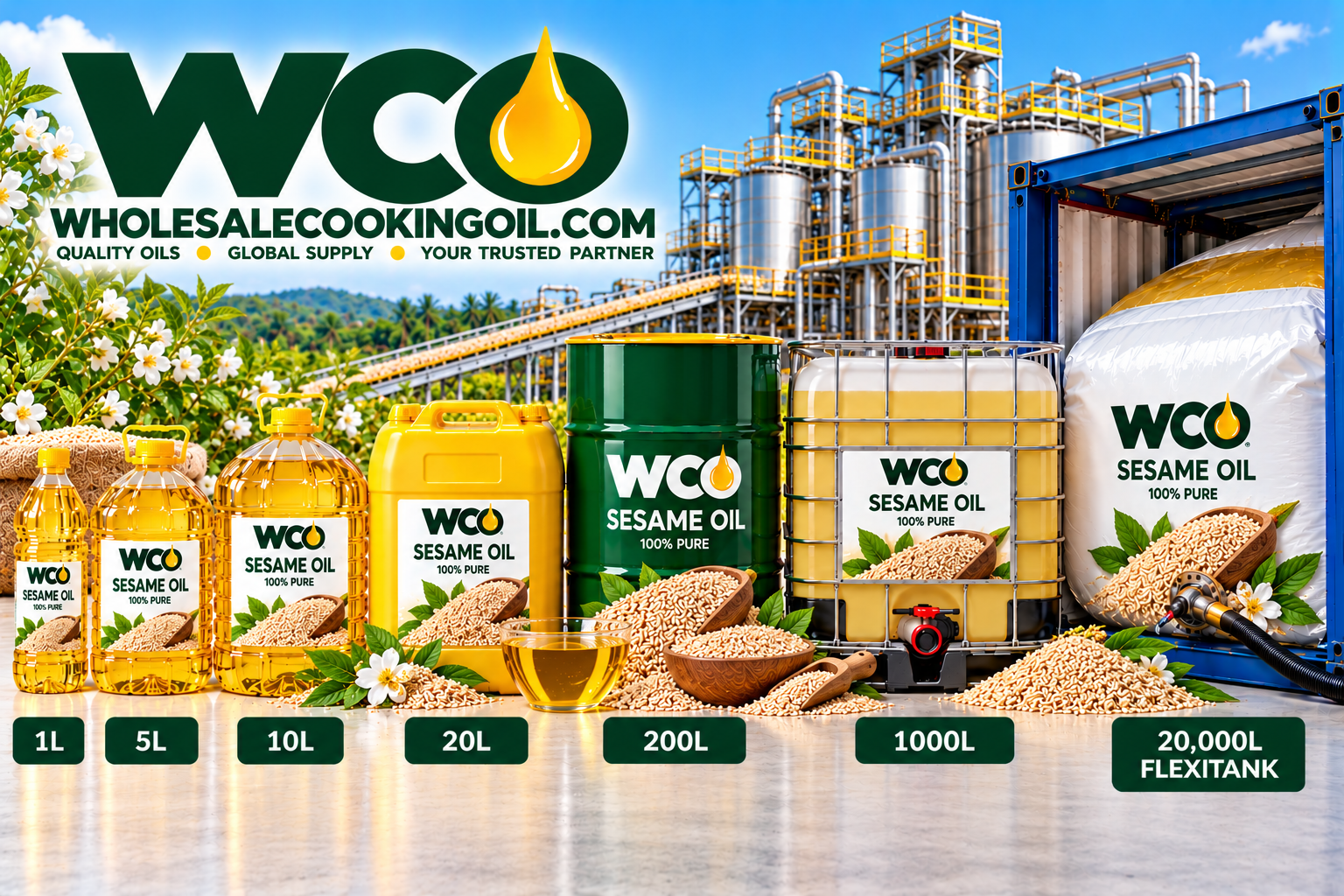
Sesame Oil
Bulk sesame oil in three grades: refined for stir-frying and cooking, cold-pressed for a gentle nutty flavor, and toasted for…
View sesame oil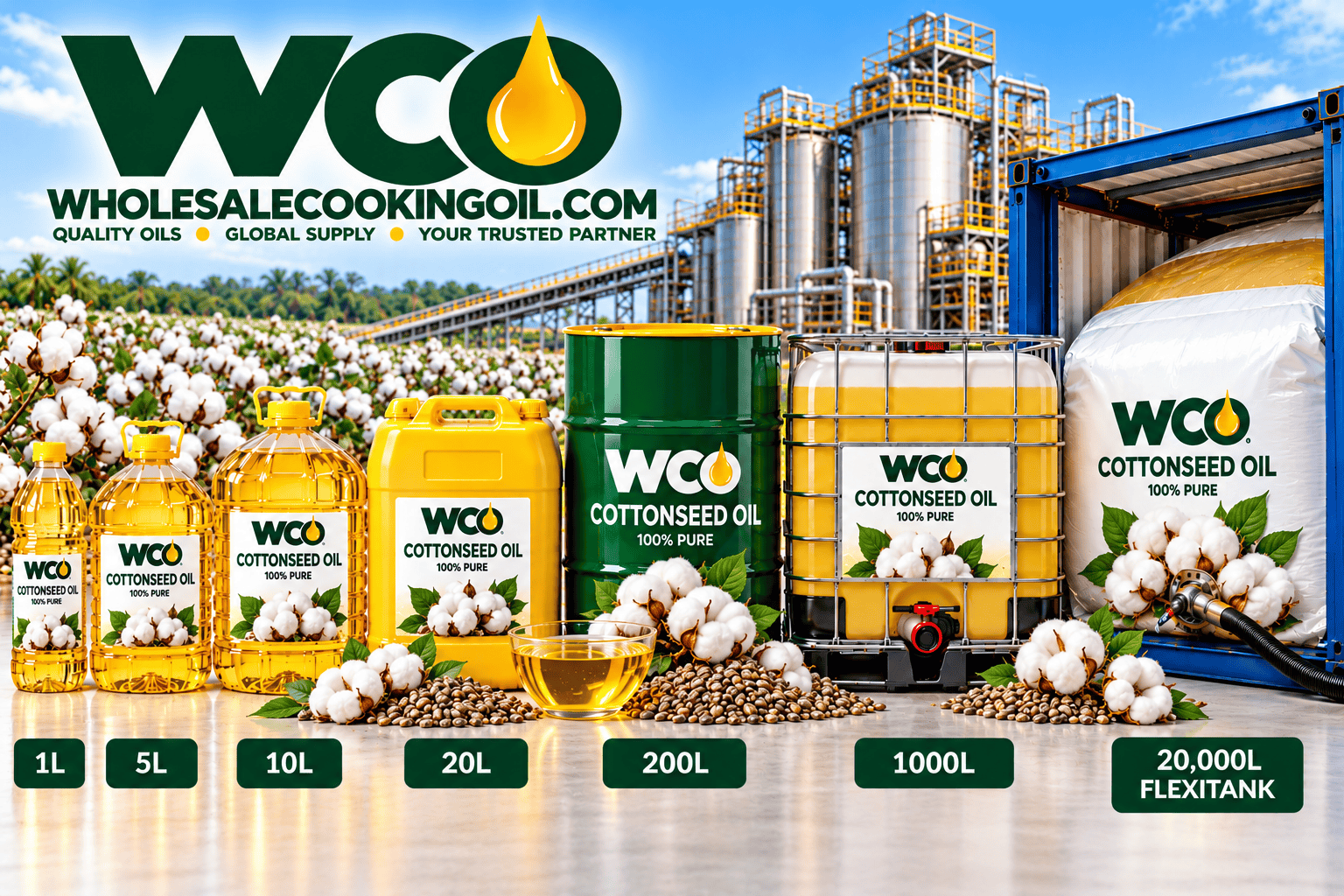
Cottonseed Oil
Bulk cottonseed oil, refined and winterized, with a mild, slightly nutty finish and excellent stability in the fryer. A classic…
View cottonseed oil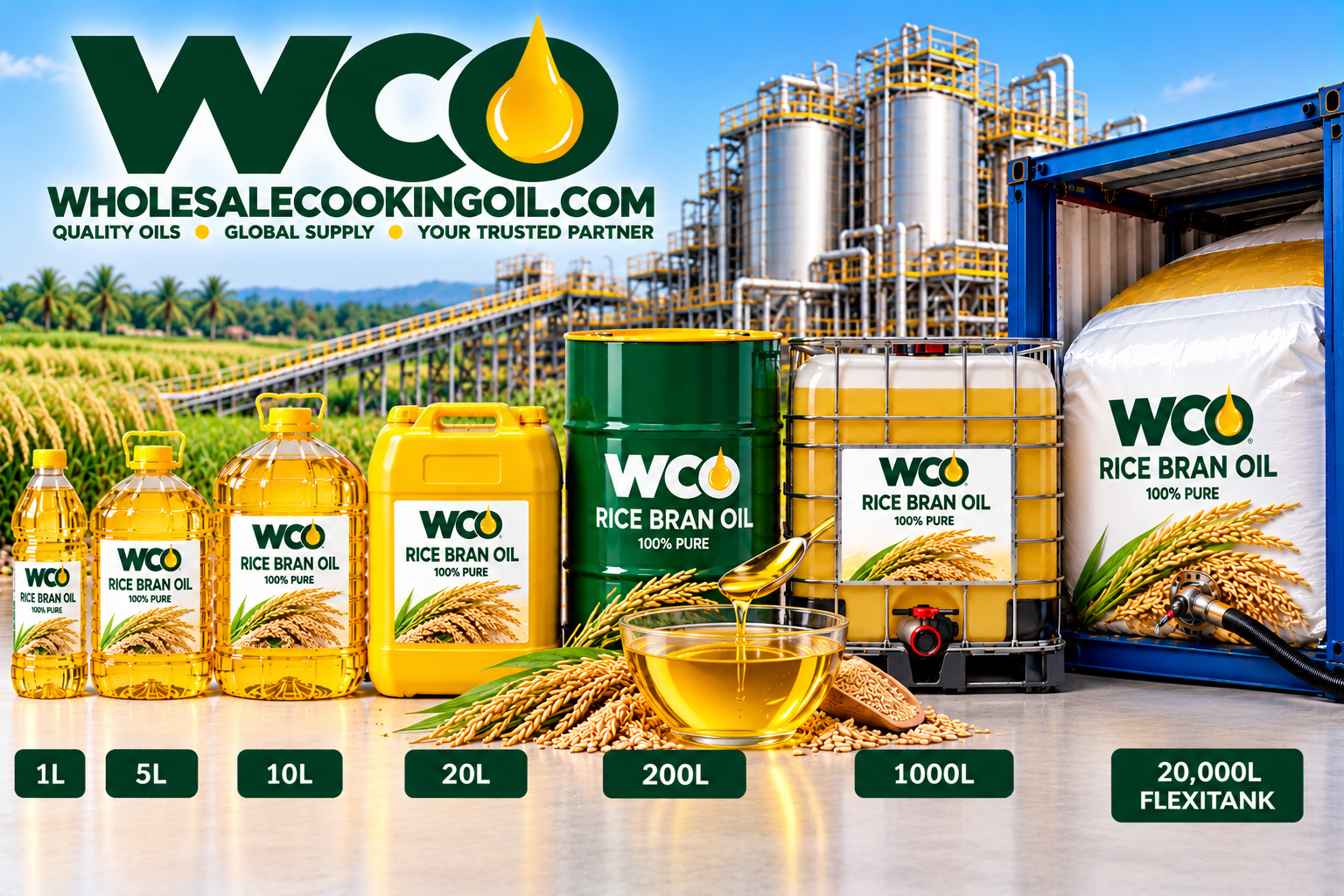
Rice Bran Oil
Bulk rice bran oil, refined for a mild taste and a smoke point of about 232 °C, with natural gamma-oryzanol,…
View rice bran oil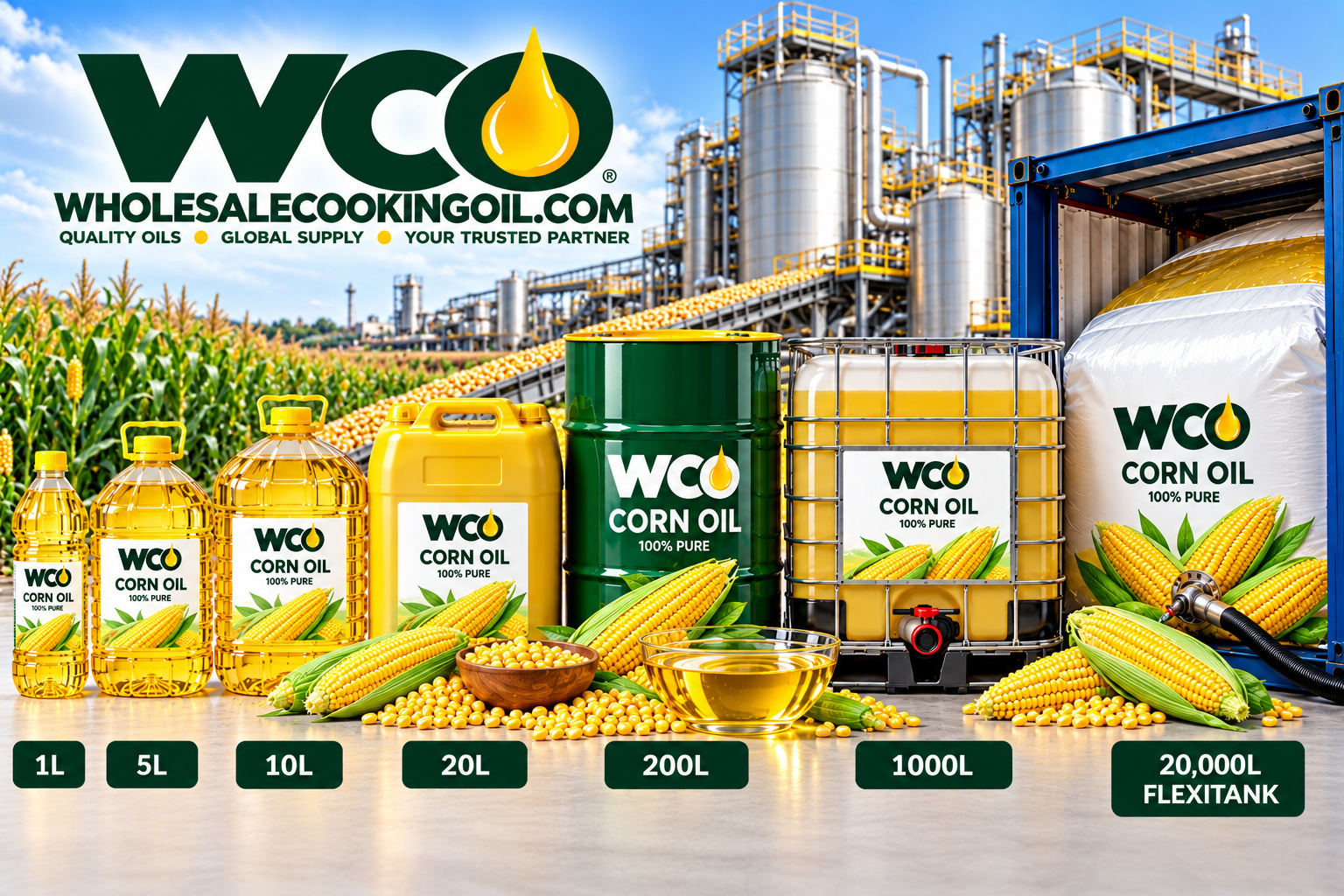
Corn Oil
Bulk corn oil, refined and winterized, with a light golden color, clean taste and high smoke point. A dependable oil…
View corn oil
High-Oleic Sunflower Oil
Bulk high-oleic sunflower oil with at least 75% oleic acid and almost no omega-3, for long fry life and extended…
View high-oleic sunflower oil
Deep Frying Oil
Bulk deep frying oil, a blend of RBD palm olein and high-oleic sunflower oil made for fryers that run all…
View deep frying oil